Showing posts with label Rim. Show all posts

Tuesday, August 30, 2011

[Web : Vesti] Holey Roman pot likely held delicate mousey morsels

By Randy Boswell, Postmedia News August 29, 2011


An 1,800-year-old clay vessel, believed to have come from the Roman Empire, thatís been put back together after being found smashed into nearly 200 pieces.
 

An 1,800-year-old clay vessel, believed to have come from the Roman Empire, thatís been put back together after being found smashed into nearly 200 pieces.

Photograph by: Handout photo, Museum of Ontario Archaeology


A Canadian museum is seeking help from archeologists around the world to solve the mystery surrounding a bizarre, 1,800-year-old clay vessel — believed to have come from the Roman Empire — that was put back together this year after being found smashed into nearly 200 pieces at a dig site in Britain.

The painstaking reconstruction, performed by experts at the Museum of Ontario Archaeology in London, Ont., has revealed a large urn intriguingly riddled with precisely spaced, dime-sized holes.

And chief among the theories about the object's strange design is that it served as a kind of cookie jar for Romans snacking between meals — except that the treats stored inside were likely small rodents.

The vessel, which has a somewhat murky provenance, is presumed to have been excavated in the 1940s at a site dating from Roman-occupied Britain and sent as a gift — still in fragments — to the Canadian museum, which is affiliated with the University of Western Ontario.

Katie Urban, an archeologist with the MOA, spent two months earlier this year piecing the metre-wide jar together after it was rediscovered as a box of pottery shards on a museum storage shelf.

"We thought originally it was part of a drain," Urban told Postmedia News. "But when we put it together, it was in the shape of a pot. It's one of those really good examples of why archeologists put pottery back together."

Her glue job revealed a startlingly complete and well-crafted clay container, similar in design to hundreds of vessels documented from ancient Rome — but rare for its holey construction, and rarer still for its unusual interior features.

It was initially thought the 30-kilogram jar might have served as a type of lamp, with light emitted from the several dozen holes punched into the body of the vessel. There's also a possibility Romans stored food items such as onions or garlic in perforated vessels, said Urban.

Yet it more closely resembles other excavated "gliraria" — Roman-era containers used to keep live dormice, which Urban said were considered a tasty delicacy among the ancient empire's upper classes.

"They would keep a bunch of little dormice, feeding them nuts and things like that to fatten them up before they would stuff them and cook them and eat them," she said. "There's a couple of different recipes known from Roman texts. It would have been a luxury item."

However, the museum's possible example of a dormouse jar lacks the usual interior ramp-like structure that allowed the little rodents to climb around in their cage while waiting to be gobbled, say, by a hungry senator or centurion.

"There's not a lot of good examples of them, but all of the ones we've seen have a kind of built-in ramp that spirals up the pot so that the mice can run up and around," she said. "Otherwise all the mice would be stuck at the bottom. If ours was like that, it must have had a secondary — possibly wooden — platform inside."
And if so, she said, the climbing structure must have disintegrated in the elements after the buried jar was reduced to rubble untold centuries ago — or more recently as the result of a Second World War bomb blast.
Incomplete records indicating how the vessel came to Canada have complicated its identification. But Urban believes the jar was included with a collection of artifacts dug up in postwar London, England — possibly from a bomb crater made during the Blitz — and shipped to Canada as part of a scholarly exchange of research material.

To pin down the vessel's identification as a dormouse container, said Urban, "we need to find something that's very similar to it, which we have not been able to find."

So the museum, best known for its archeological holdings from prehistoric First Nations communities in Canada, has highlighted the mysterious jar as part of a new exhibition showcasing the MOA's relatively small collection of Old World artifacts.

The hope, said Urban, is that stoking public and scholarly interest in the hole-filled vessel will lead to a more certain understanding of its origins, purpose and design.


Read more: http://www.canada.com/Holey+Roman+likely+held+delicate+mousey+morsels/5323628/story.html#ixzz1WVNtzEcP

Friday, August 26, 2011

[Web : Vesti] ROMAN SHIPWRECK FULL OF WINE JARS FOUND

American and Albanian archaeologists have discovered a well preserved Roman shipwreck full of wine jars off the coast of Albania.

Dating to the 1st century B.C., the 98 foot-long cargo ship was found about 130 feet deep near the port city of Vlora.
Most of the of the jars, or amphoras, lay unbroken on the sea floor. Unfortunately, they were empty, since their stoppers had gone.
"The ship is one among five ancient wrecks we discovered last month.The other four were just north in Montenegro," archaeologist Jeff Royal, of the RPM Nautical Foundation, told Discovery News.
The coasts of both Albania and Montenegro remained unexplored until 2007, when Florida-based RPM Nautical Foundation initiated a coastal survey aimed at identifying submerged archaeological artifacts in both countries.
"Thus far nine ancient wrecks have been discovered in Montenegro and eight in Albania that span the period of the 6th century B.C. through the 4th century A.D.," said Royal.
According to Royal, three of the shipwrecks discovered this season are associated with a flourishing wine trade industry in what is now central Croatia.


The trade developed shortly after the Roman entry into ancient Illyria, a region in the western part of the Balkan Peninsula which included present-day Albania.
"Large cargoes of these amphoras were shipped down the eastern Adriatic coast from Croatia, along the modern Montenegrin and Albanian coasts to about Vlore where most traversed westward and rounded Italy into the western Mediterranean," said Royal.
The sites will be left unexplored, and the retrieved jars restored to the wrecks, until local archaeologists will be in a position to carry the excavations.
"These finds provide each country's government the opportunities to protect their cultural heritage, train their first maritime archaeologists, and collaborate with established institutions in further study," Royal said.


Tuesday, August 16, 2011

[Web : Vesti] Rare statue of Hercules discovered in Northern Israel

A rare statue depicting the Roman god Hercules has been discovered during an excavation in the Jezeel Valley in the north of Israel. 

By Phoebe Greenwood in Tel Aviv

16 August 2011

The white marble figure stands at 0.5 metres and is thought to have originally decorated an alcove in a Roman bathhouse. It has been dated to the second century AD and is said to be of exceptional quality.

Dr Walid Atrash of the Israel Antiquities Authority said: "This statue is unusual because it is small. Most statues of gods from this period were life-size. This is something special."

The demigod is depicted leaning on a club, draped with the skin of the Nemean lion that he slew in the first of his twelve labours.

The son of Zeus and the mortal Alcemene, Hercules was ordered to undertake twelve superhuman feats, known as 'The Labours of Hercules', by the Mycenaean King Eurystheus to atone for the murder of his wife and three children in a fit of mad rage.

The statue was discovered in Hovrat Tarbenet during work on the new Valley Rail line, which will run through the Jezreel Valley connecting the northern port of Haifa with Bet She'an on the Jordan border. Excavations have only recently begun on this site and Dr Atrash believes this may be the first of many archaeological discoveries.

The Jezreel valley was an important stop along the Roman Via Maris, an ancient trade route connecting Egypt to Mesopotamia, or modern day Iraq.


Friday, August 12, 2011

[Web : Vesti] ROMAN-ERA SWORD UNCOVERED IN ANCIENT DITCH, Discovery News

Analysis by Rossella Lorenzi


A sword used by a Roman soldier during the brutal pacification of the Jews and the destruction of the Temple at Jerusalem nearly 2,000 years ago, has emerged from an ancient drainage tunnel beneath the city, Israeli authorities announced this week.
Excavated since 2007, the tunnel, which was used by Jewish rebels as a hiding place from the Romans, has also yielded a stone object adorned with a rare engraving of a menorah, the seven-branched temple candelabra that was the symbol of ancient Judaism.
The 60-centimetre (23.6-inches) long weapon, still in its leather scabbard, is the third Roman sword found in Jerusalem.
What makes the finding unique is the fine state of preservation, said the excavation directors Eli Shukron of the Israel Antiquities Authority and Ronny Reich of the University of Haifa.
"It seems that the sword belonged to an infantryman of the Roman garrison stationed in Israel at the outbreak of the Great Revolt against the Romans in 66 AD," the researchers said in a statement.
At that time, the Jewish people revolted against the tyranny of Rome, but despite a remarkable resistance, they were ultimately crushed.
The Romans also destroyed the second Temple, which, according to Jewish tradition, was built by King Herod the Great on the site of King Solomon’s temple. This was razed by the Babylonians around 587 BC.
In 70 AD, the Romans under Titus plundered tons of gold, silver trumpets and gold candelabra from Herod’s magnificent white-and-gold temple. Then they paraded the treasure, which also helped finance the building of the Colosseum, through the streets of Rome in triumph.
Menora
The stone engraved with the image of the menorah. Courtesy of Vladimir Naykhi
The moment was captured in a frieze carved into the Arch of Titus, which clearly shows the menorah, the seven-branched temple candelabra, being exposed through the streets.
The menorah was also recorded in a stone object unearthed near the Temple Mount.
"Interestingly, even though we are dealing with a depiction of the seven-branched candelabrum, only five branches appear here. The portrayal of the menorah’s base is extremely important because it clarifies what the base of the original menorah looked like, which was apparently tripod shaped," the researchers said.
The fact that the stone object was found near the Temple Mount would suggest that it belonged to a passerby who saw the menorah with his own eyes.
"Amazed by its beauty, he incised his impressions on a stone and afterwards tossed his scrawling to the side of the road, without imagining that his creation would be found 2,000 years later," the researchers said


[Web : clanak] Lampe – otisak rimskog uma, Politika

Izložba antičkih svetiljki u Konaku kneginje Ljubice otkriva koliko je svetlost bila važna za svakodnevni život Singidunuma i kako su Rimljani od njih napravili umetnost, ali i unosan posao


Bez svetlosti lampi nije bilo smrti, umiranja ni sahranjivanja. Nije bilo molitve, hramova ni bazilika. Zato su Rimljani morali da postanu majstori za njihovu izradu. Svetlost lampi dopirala je do svih krajeva gde su stizale rimske legije.
O širenju kulture Rima i kulta svetlosti svedoče i lampe iz Singidunuma, sada predstavljene na izložbi „Dobro svetlim – antičke svetiljke iz Muzeja grada Beograda”.
Autorka postavke u Konaku kneginje Ljubice dr Slavica Krunić izabrala je najlepše primerke pronađene, u najvećem broju slučajeva, u prvom veku u starom Beogradu.
– Prve lampe su starije, helenističke, iz četvrtog veka p. n. e. Rimljani su ih nasledili, oslikavali i usavršavali – ističe dr Krunić.
Konak će do 30. septembra biti dom za tri helenističke, 28 rimskih keramičkih, sedam bronzanih, sedam kasnoantičkih i jednu staklenu lampu. Ima ih više vrsta: serijske, ali i one posebne, sa erotskim motivima, predstavama Meduze, Dionisa, religijskog obreda, građanina, ljudske glave, lava, pantera, zeca, delfina. Tu su i firma-lampe sa žigom radionice koja ih je napravila, one sa više fitilja koje su bacale jaču svetlost, kao i prstenaste lampe za plafon trpezarije.
– Lampe su koristile skupa goriva: maslinovo, orahovo, laneno i ricinusovo ulje. Prve svetiljke su bile otvorene i iz njih se prosipala dragocena tečnost, tako da su ih ubrzo zatvorili.
Izložene su i amfore za prenos ulja, pincete za vađenje fitilja i kalupi.
– Imamo i figuralne lampe u obliku šišarke, Amora ili rimske sandale, koja je korišćena zbog simbolike tvrdog đona – on štiti na putu u zagrobni život. One su bile skuplje jer se kalup razbijao posle jedne izrađene svetiljke, za razliku od serijskih kod kojih je kalup dugo trajao.
Vrednije lampe privlačile su bogatije kupce koji su često kupovali i bronzane svetiljke, za razliku od siromašnijih stanovnika Singidunuma koji su nabavljali keramičke.
I najsiromašniji, koji su se oslanjali na svetlost sunca i ognjišta, posedovali su makar jednu svetiljku koja im je služila za molitvu i sahranjivanje.
– Porodica pokojnika stavljala je lampu na prag i tako obaveštavala rođake i komšije o smrti u svojoj kući. Telo na odru okruživale su četiri velike sveće. Svetiljke su ostavljene i u grob da bi umrlom osvetljavale put.
Značaj beogradske zbirke je i u tome što ona krije lampu sa natpisom. Svetiljke sa kratkom pričom su retke i pronađeno ih je samo šest u zemljama Rima. Na njoj piše „dobro svetlim”, što je autorka izložbe pozajmila za ime postavke.
Recenzent monografije koja prati izložbu dr Ivana Popović ističe da se na primeru ovog natpisa i lampi uopšte primećuje praktičnost rimskog uma.
– Serijski pravljene lampe počeci su masovne proizvodnje. Mnogo ih je pravljeno pa je sve trebalo i prodati. Zato su Rimljani posegli za marketingom. Oni su izmislili reklamu kao što to pokazuje natpis „dobro svetlim” – kaže dr Popović.
Ona kaže da su Rimljani prvi počeli i sa brendiranjem jer se samo tako i može shvatiti to što su radionice na dnu lampi utiskivale svoj žig.
– To su mali predmeti za svakodnevnu upotrebu, ali mnogo otkrivaju o širenju uticaja Rima u Singidunumu, kao i o tome kako su Rimljani činili život lakšim i lepšim.
----------------------------------------------
Seljenje proizvodnje – rimski izum
Rimljani su bili preteče ne samo reklame i brendiranja, već i preseljenja proizvodnje zarad veće dobiti. Kako objašnjava dr Slavica Krunić, Singidunum je obilovao ne samo lampama iz Italije, već i svetiljkama napravljenim na sopstvenom tlu.
– Rimljani su shvatili da im je jeftinije da robove presele u Singidunum gde bi im otvarali radionice, nego da transportuju lomljive lampe iz Italije. Sve je funkcionisalo. Preneli bi kalupe, uposlili robove i ubirali zaradu. Slična je današnja logika preseljenja proizvodnje u Kinu.
J. Stevanović
objavljeno: 12.08.2011.

Saturday, August 6, 2011

[Web : Vesti] England's western-most Roman town uncovered


A chance discovery of coins has led to the bigger find of a Roman town, further west than it was previously thought Romans had settled in England.

The town was found under fields a number of miles west of Exeter, Devon.

Nearly 100 Roman coins were initially uncovered there by two amateur archaeological enthusiasts.
It had been thought that fierce resistance from local tribes to Roman culture stopped the Romans from moving so far into the county.

Sam Moorhead, national finds adviser for Iron Age and Roman coins for the PAS at the British Museum, said it was one of the most significant Roman discoveries in the country for many decades.

"It is the beginning of a process that promises to transform our understanding of the Roman invasion and occupation of Devon," he explained.

After the coins were unearthed by the local men out using metal detectors, Danielle Wootton, the University of Exeter's liaison officer for the Portable Antiquities Scheme (PAS), which looks after antiquities found by the public, was tasked with investigating further.

After carrying out a geophysical survey last summer, she said she was astonished to find evidence of a huge landscape, including at least 13 round-houses, quarry pits and track-ways covering at least 13 fields, the first of its kind for the county.

"You just don't find Roman stuff on this scale in Devon," said Ms Wootton. 

She carried out a trial excavation on the site, and has already uncovered evidence of extensive trade with Europe, a road possibly linking to the major settlement at Exeter, and some intriguing structures, as well as many more coins.

"This was a really exciting discovery," said Ms Wootton. But she said most exciting of all was that her team had stumbled across two burial plots that seem to be located alongside the settlement's main road.

"It is early days, but this could be the first signs of a Roman cemetery and the first glimpse of the people that lived in this community," she explained.
Romans in Devon
 
Not enough excavation has been done yet to date the main occupation phase of the site, but the coins that were found range from slightly before the start of the Roman invasion up until the last in 378AD.
The Romans reached Exeter during the invasion of Britain in AD 50-55, and a legion commanded by Vespasian built a fortress on a spur overlooking the River Exe. This legion stayed for the next 20 years before moving to Wales.

A few years after the army left, Exeter was converted into a bustling Romano-British civilian settlement known as Isca Dumnoniorum with all the usual Roman public buildings, baths and forum.

It was also the principal town for the Dumnonii tribe, a native British tribe who inhabited Devon and Cornwall. It was thought that their resistance to Roman rule and influence, and any form of 'Romanisation' stopped the Roman's settling far into the south west.

For a very long time, it was thought that Exeter was the limit of Roman settlement in Britain in the south west, with the rest being inhabited by local unfriendly tribes.

Some evidence of Roman military occupation has been found in Cornwall and Dartmoor, thought to be protecting supply routes for resources such as tin.


Devon fields  
Could more settlements be found under fields in Devon in the next few years?
 
However on this site, more than just the coins are Roman. Pottery and amphora fragments recovered suggest the town embraced trading opportunities in Europe that came with Roman rule, and a fragment of a Roman roof tile has also been found.

Danielle Wootton received some funding from the British Museum, the Roman Research Trust and Devon County Council in June to carry out the trial excavation but said more money was needed as they still had not reached its outer limits.

"We are just at the beginning really, there's so much to do and so much that we still don't know about this site.
"I'm hoping that we can turn this into a community excavation for everyone to be involved in, including the metal detectorists," she explained.

Sam Moorhead said he believed more Roman settlements may be found in the area in the next few years.

The excavation of this unique site will feature in the forthcoming BBC Two series Digging For Britain.

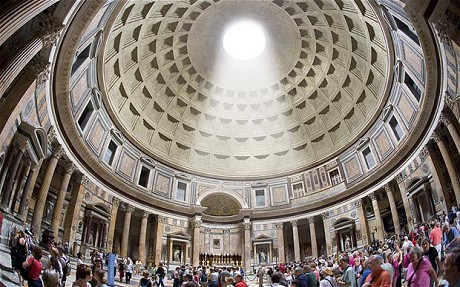
[Web : Vesti] Rome's Pantheon may have been built as a massive sundial researchers reveal , The Telegraph

It is one of the best preserved buildings from the Roman world, a 2,000-year-old testament to the immense power and wealth of the empire. 

But mystery has always surrounded what lies behind the unusual design of the Pantheon, a giant temple in the heart of Rome that was built by the Emperor Hadrian.
Now experts have come up with an intriguing theory – that the temple acted as a colossal sun dial, with a beam of light illuminating its enormous entrance at the precise moment that the emperor entered the building.
Constructed on Hadrian's orders and completed in AD128, the Pantheon's hemispherical dome is punctured by a 30ft-wide circular hole known as the 'oculus'.
It provides the interior of the building with its only source of natural light and allows in rain and – on rare occasions – snow.
Giulio Magli, a historian of ancient architecture from Milan Polytechnic, Italy, and Robert Hannah, a classics scholar from the University of Otago in New Zealand, have discovered that at precisely midday during the March equinox, a circular shaft of light shines through the oculus and illuminates the Pantheon's imposing entrance.


They have been working on the theory since 2009 but recently brought together all their latest research in a paper published in a scholarly journal, Numen.
The precise calculations made in the positioning and construction of the Pantheon mean that the size and shape of the beam perfectly matches, down to the last inch, a semicircular stone arch above the doorway.
A similar effect is seen on April 21, which the Romans celebrated as the founding date of their city, when at midday the sun beam strikes a metal grille above the doorway, flooding the colonnaded courtyard outside with light.
The dramatic displays would have been seen by the Romans as elevating an emperor into the realm of the gods – a cosmological affirmation of his divine power as he entered the building, which was used as an audience hall as well as a place of worship.
He was in effect being "invited" by the sun to enter the Pantheon, which as its name suggests was dedicated to the most important deities of the Roman world.
"The emperor would have been illuminated as if by film studio lights," said Professor Magli. "The Romans believed the relationship between the emperor and the heavens was at its closest during the equinoxes.
It would have been a glorification of the power of the emperor, and of Rome itself." The sun had a special significance for the Romans, as it did for the ancient Egyptians. The god Apollo was associated with the sun, and the emperor Nero was depicted as the Greek sun god Helios in a giant statue called the Colossus, which gave its name to the Colosseum.
One of antiquity's most remarkable examples of engineering, the Pantheon's fine state of preservation is thanks to the fact that it was converted into a church in the seventh century, when it was presented to the Pope by the Byzantine Emperor Phocas.
It retains its original bronze doors and marble columns, some of which were quarried in the Egyptian desert and transported by the ship down the Nile and across the Mediterranean to Rome at huge expense.
The building now contains the tombs of Victor Emmanuel II, the first king of united Italy, and the Renaissance artist Raphael.


Thursday, July 14, 2011

[Web] Assisi's Roman Villa,

by Marco Merola


A surprise discovery under a medieval Italian town square
cubiculum

Found among the well-preserved remains of a Roman villa inhabited until the 1st century A.D. was a cubiculum, or bedroom, decorated with frescoes and an intricate geometric mosaic. 
(Courtesy Soprintendenza Archeologica dell’Umbria)
On September 26, 1997, a strong earthquake shook the central Italian town of Assisi, birthplace of St. Francis. The quake damaged dozens of medieval buildings and shattered into tens of thousands of pieces the frescoes that covered the walls and ceiling of the Basilica of St. Francis. These include thirteenth-century frescoes by the greatest early Renaissance masters—Giotto, Cimabue, Simone Martini, and Pietro Lorenzetti. (After five years and millions of dollars, the frescoes were restored to as close to their original condition as possible.) But just half a mile from the Basilica, untouched by the earthquake, lay other beautiful frescoes that once covered the walls of a first-century A.D. Roman villa.
Four years after the earthquake, authorities began to stabilize and modernize some of Assisi’s oldest structures. They decided that one of these buildings, the seventeenth-century Palazzo Giampè, which houses the town’s court, would get an elevator. This required engineers to dig deep down to the building’s foundations. But work stopped almost immediately. Only 20 inches below the entrance, builders had begun to find pieces of stucco of a kind that is often found decorating ancient Roman column capitals. “Right away we had to start a real excavation,” says Maria Laura Manca of the Archaeological Superintendent’s office in Umbria, who supervised the dig. Soon the archaeologists had uncovered three 14- to 15-foot-tall columns that formed the peristyle (a colonnaded space with a central garden) of a very large house. “We had not ever expected a discovery of this kind,” says Manca. “We were astounded.”

http://www.archaeology.org/

Wednesday, July 13, 2011

[Web : Vesti] Archeologists discover a hoard of silver Roman denarii coins at Vindolanda


Ahoard of twenty one silver denarii has been recovered during the recent excavation of the foundations of a clay floor in a centurion’s apartment of the late Antonine period (cAD180-200) at Vindolanda, northeast England.
The hoard had been buried, possibly in a purse or some similar organic package which had long since rotted away, in a shallow pit within the foundation material of the floor of the structure in the middle of the room.
Dr Andrew Birley – director of excavations at the site explains, “The coins were tightly packed together and several had corroded onto one another, held together as a group by the foundation clay of the building on the surrounding packaging that had rotted away. The surface area covered by the coins was no greater than 10cms, suggesting that there had been little movement by post depositional processes. The archaeological context suggests that the hoard may well have been deliberately buried, rather than lost, and was probably the savings of an individual who was unable to recover his money.”
Twenty-one denarii in the late second century represented a substantial sum being roughly one tenth of a ranking auxiliary’s gross annual salary
Twenty-one denarii in the late second century represented a substantial sum being roughly one tenth of a ranking auxiliary’s gross annual salary and the equivalent of perhaps two or three thousand pounds in today’s money.
The hoard has now been conserved at Vindolanda and reported as treasure trove under the 1996 Treasure Act. It is hoped that the hoard will remain at Vindolanda, as part of the site archive, and for public display at the Vindolanda Trust’s site museum.

More information


Read more >> http://www.pasthorizonspr.com/index.php/archives/07/2011/archaeologists-discover-a-hoard-of-silver-roman-denarii-coins-at-vindolanda#ixzz1S2GNPy6g 
Read the Archaeology News - then buy the Trowel at Past Horizons Tools

[Web : Vesti] Caligula Statue Seized From Looters Is Unveiled


A statue believed to depict the Roman emperor Caligula was officially unveiled in Rome on Tuesday, six months after police seized it from looters. Archaeologists are currently excavating the spot where it was found, which may prove to be the site of a long-lost imperial villa.

Yesterday, Italian authorities unveiled a giant statue thought to represent the ancient Roman emperor Caligula. Police confiscated the 8-foot-tall marble figure in January after spotting a man loading it into a truck near Lake Nemi, located south of Rome. Two men were later arrested for unlawfully excavating a nearby site. It is believed that they planned to smuggle the statue and other archaeological finds out of the country and sell them on the black market.
In the months since the seizure, experts have cleaned the 2,000-year-old statue, which was already in a dilapidated state and had been broken into pieces by the plunderers. Its subject, who is cloaked in a robe and seated on a throne, was identified as Caligula because his foot is encased in a “caliga”—a type of boot worn by Roman legionary soldiers that gave the emperor his nickname. According to Suetonius, who chronicled the history of Rome in the first century, Caligula, born Gaius Julius Caesar Germanicus in 12 A.D., accompanied his father on military campaigns as a small child. His miniature uniform inspired soldiers to dub him Caligula, meaning “little boots.”
His unintimidating pet name notwithstanding, Caligula grew up to earn a reputation as a tyrannical ruler, characterized by ancient historians as violent, narcissistic, sex-crazed, incestuous and completely insane. (Some contemporary scholars have questioned the neutrality of these assessments, while others have attributed Caligula’s alleged madness to medical conditions or lead poisoning.) He died at the hands of his own personal guard in 41 A.D., less than four years into his reign.
Thanks to the statue’s recovery, we may soon gain a deeper understanding of one of ancient Rome’s most infamous emperors. In April, Italian archaeologists began excavating the site where the smugglers had conducted their illegal dig. So far, they have unearthed the ruins of what was initially thought to be a mausoleum but now appears to be a thermal bathing complex. They have also found more than 250 artifacts, including additional pieces of the broken statue.
The project has generated significant interest among historians because Caligula is known to have spent time in the Lake Nemi region and may have had an imperial villa there. He also kept two ships, described by Suetonius as lavish pleasure boats used for merrymaking, anchored on the lake; their remains were recovered in the 1930s. Perhaps further excavation will reveal whether a botched robbery led archaeologists to Caligula’s long-lost palace.


Tuesday, July 12, 2011

[Web : Vesti] Caligula statue discovered by 'tomb raiders' unveiled in Rome


A massive statue believed to be a rare image of Roman emperor Caligula sitting on a throne has been unveiled in Rome.

Officials said that it came from an illegal dig south of the Italian capital, and that may have been the site of one of his palaces.
The statue, which had been broken in several large pieces and a head, was first found last January when finance police stopped it from being smuggled out of the country by boat at a port near Rome.
The operation led to the arrest of two so-called "tomb raiders" – those who dig up the countryside looking for archaeological treasures to sell on the black market.
But more importantly, the arrests led police to the site near Lake Nemi, just south of Rome, where Caligula was believed to have had one of his imperial residences.
The statue, now cleaned of the earth that had covered it for 2,000 years, shows parts of a robed man sitting on an elaborate throne like the Greek god Zeus.
Significantly, it shows a man wearing a "caliga," shoes worn by Roman legionaries and from where the emperor got his nickname. His real name was Gaius Julius Caesar Augustus Germanicus.
Caligula, who reigned from 37 to 41AD, has gone down in history as a crazed and power-hungry sex maniac who demanded that his horse, Incitatus, be made a consul.

The Telegraph

Thursday, July 7, 2011

[Web : Vesti] Hadrijanovoj vili preti urušavanje


Hadrijanova vila, rezidencija slavnog rimskog cara u blizini Rima, delimično je zatvorena za posetioce zbog opasnosti od urušavanja zbog nedostatka novca za održavanje lokaliteta.
Smešten u Tivoliju, 10-ak kilometara od glavnog grada Italije, taj kompleks zdanja prostire se na 80 hektara (što je više od Pompeje) a dobio je samo 370.000 evra od 2,5 miliona koje konzervatori smatraju minimalnom sumom potrebnom za održavanje. 

Za tri godine, od 6,7 miliona evra traženih za konzerviranje vile, deblokiran je samo milion i po, pa zato svake godine raste broj zona kompleksa zaštićenih metalnim ogradama sa natpisom "opasnost od rušenja". 

Vila je podignuta u periodu između 117. i 138. godine nove ere, po naređenju cara Hadrijana, a nacrt zgrada i konstrukcija inspirisan je delima i lokalitetima koje je imperator posećivao tokom mnogobrojnih putovanja po rimskom carstvu.

Wednesday, June 22, 2011

[Web : Vesti] A Herculean effort


After nearly 20 years, and €16m spent on restoration, an archaeological site dedicated to Hercules is set to open to the public
TIVOLI/ROME. On 23 June, the Sanctuary of Hercules in Tivoli, Italy will open to the public for the first time following years of restoration work and significant investment.
Built at the end of the second century AD as a place of worship in honour of Hercules the Victor, the vast complex has had a tumultuous history. After a period of abandonment, from the 18th century onward it became the site of various industrial ventures including a gunpowder factory, a paper-mill and Italy’s first hydroelectric power plant.
Since 1983, around €11 million has been spent on excavating and renovating the site and in 2008 a further €5 million was allocated to the Department of Archaeological Heritage, Lazio for the regeneration project which is now nearing its completion.
A museum has been constructed to house important archaeological finds from the site, and the restored 700-seat open air theatre will present a calendar of events throughout the summer. In addition to its rich Roman heritage, the new centre will also embrace its role in the history of Italian civil engineering. Proposals have been invited on how to best redevelop the paper mill and the winning submission will be announced during the opening.